
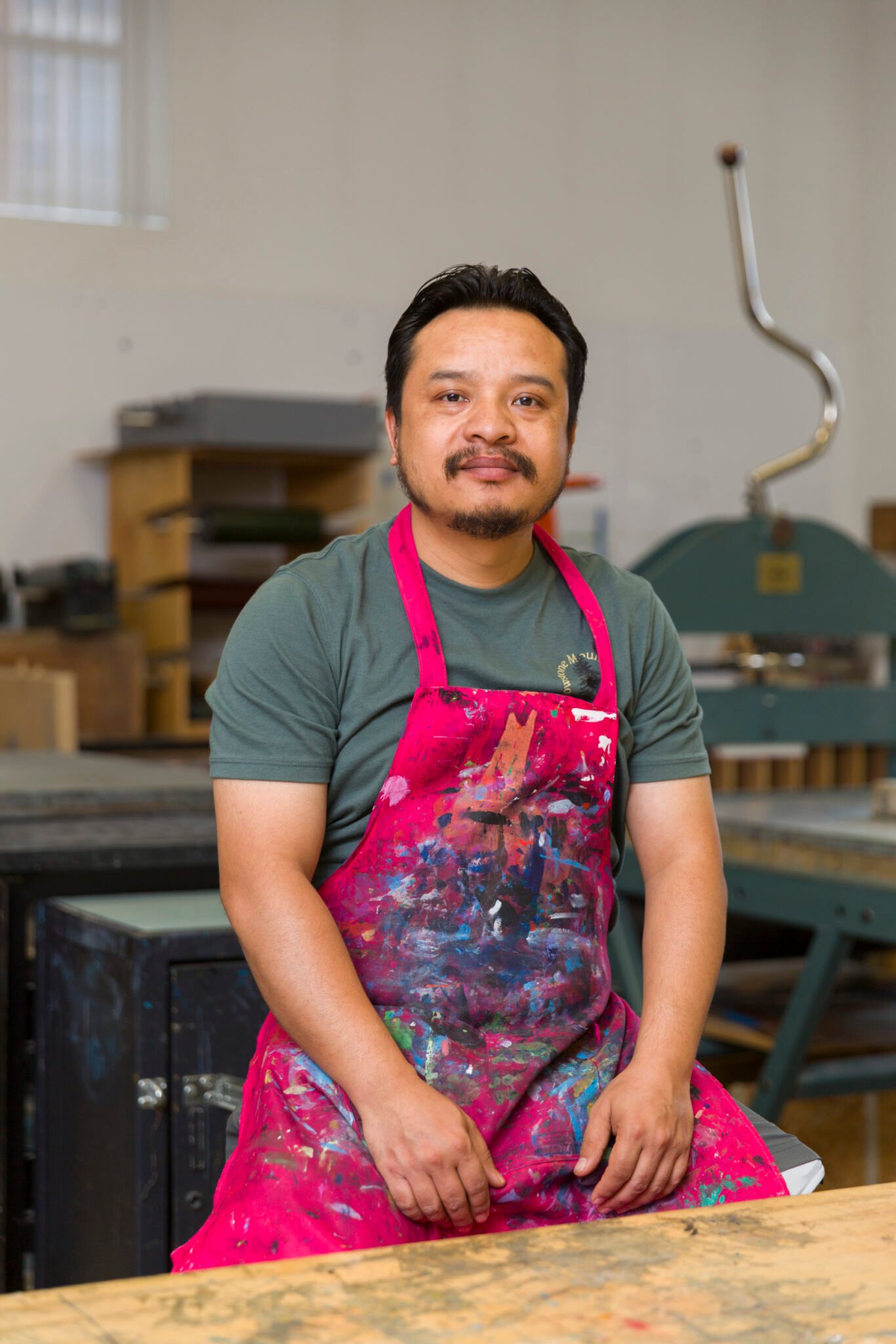
Kabi Raj Lama’s art is shaped by lived experiences of natural disasters and their enduring psychological, cultural, and spiritual impact. During his formative years as a young artist, he directly confronted two such events: the 2011 tsunami in Japan and
later the 2015 Gorkha earthquake in Nepal. These encounters profoundly altered his understanding of impermanence, belief, and survival, and they continue to inform his artistic practice.
The tremors caused irreparable damage to Nepal’s diverse and living heritage. It destroyed hundreds of centuries-old monuments, sculptures, murals, and architectural artifacts. Not just mere objects, but a presence embedded in daily life, faith, and memory. In response Lama began archiving and artistically responding to these endangered sculptures and architectural designs from heritage sites, directly copying and studying them.
Raised in a Indigenous Tamang community for whom printing is a way of life, he was naturally drawn to printmaking and papermaking. And while his cultural and ethnic
roots brought him to the medium, it is the form’s complexity and capacity that sustains his stewardship. Lama primarily work with lithography, woodcut, and intaglio, while continually experimenting with new tools, materials, and methods.
Since 2018, he has collaborated with a neuroscientist at MIT to explore and document the therapeutic potential of printmaking. his artistic practice seeks to transform trauma into a space for healing, reflection, and contemplation of the human condition-acknowledging uncertainty while honoring resilience.
Lama earned a BFA form Kathmandu University, studied printmaking at Meisei University in Japan and MFA from Mason Gross School of Art, Rutgers University.